Description
A layer that requests images from a tiled image server based on a URL template.
It provides a simple way to integrate non-ArcGIS Services as a layer in a map. The URL template usually follows a pattern similar to "https://{subDomain}.server.org/path/{level}/{col}/{row}.png", where:
- "subDomain" is one of the strings in the subDomains list
- "level" corresponds to a zoom level
- "col" represents the column of the tile
- "row" represents the row of the tile.
The URL should be arranged to reflect how the tiles are organized in the cache or on the server, and can point to a web server ("https://...") or to a local file cache ("file://...").
The tiles retrieved by this class are accessed directly by URL. Because the service is only providing images, you are responsible for manually setting the attribution text on the map or scene view.
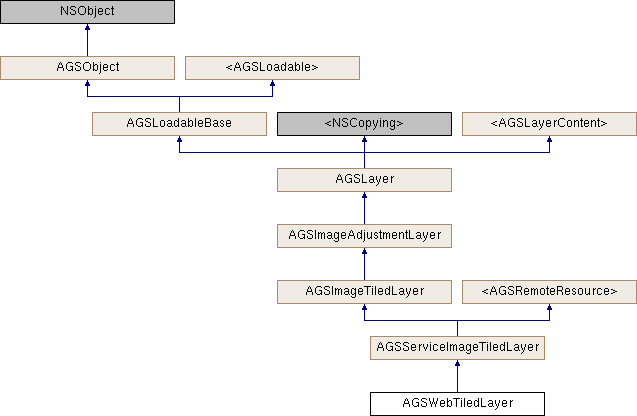
To create a custom service tiled layer whose URL follows the above pattern (or a similar pattern), you can extend this class. Alternatively, you can extend the super class AGSServiceImageTiledLayer, in which you implement a required method to set the request information for a given LOD, column, and row. Extending AGSWebTiledLayer, however, has no such requirement.
Functional characteristics Tiles are fetched on demand using the specified URL template. Tiles are typically prerendered (cached) on the server but may be generated on demand by some services. Web tiled layers do not support identify, query, selection, or time.
Specifying subdomains from which the layer will request tiles allows the load to be more evenly distributed among servers.
Performance characteristics Web tiled layer requires a connection to the service at all times. Performance is similar to other raster tile layers.
- See also
AGSLayer, Sample: Web tiled layer
- Since
- 100.1
Instance Methods | |
| (void) | - cancelLoad |
| (id< AGSCancelable >) | - fetchLegendInfosWithCompletion: |
| (instancetype) | - initWithTileInfo:fullExtent: |
| (instancetype) | - initWithURLTemplate: |
| (instancetype) | - initWithURLTemplate:subDomains: |
| (instancetype) | - initWithURLTemplate:subDomains:tileInfo:fullExtent: |
| (instancetype) | - initWithURLTemplate:tileInfo:fullExtent: |
| (BOOL) | - isEqualToLayer: |
| (BOOL) | - isVisibleAtScale: |
| (void) | - loadWithCompletion: |
| (void) | - respondWithNoDataTileForTileKey: |
| (void) | - respondWithTileKey:data:error: |
| (void) | - retryLoadWithCompletion: |
Class Methods | |
| (instancetype) | + imageTiledLayerWithTileInfo:fullExtent: |
| (instancetype) | + webTiledLayerWithURLTemplate: |
| (instancetype) | + webTiledLayerWithURLTemplate:subDomains: |
| (instancetype) | + webTiledLayerWithURLTemplate:subDomains:tileInfo:fullExtent: |
| (instancetype) | + webTiledLayerWithURLTemplate:tileInfo:fullExtent: |
Properties | |
| NSString * | attribution |
| float | brightness |
| void(^ | cancelTileRequestHandler )(AGSTileKey *tileKey) |
| BOOL | canChangeVisibility |
| float | contrast |
| AGSCredential * | credential |
| AGSEnvelope * | fullExtent |
| float | gamma |
| BOOL | identifyEnabled |
| AGSItem * | item |
| NSString * | layerDescription |
| NSString * | layerID |
| NSError * | loadError |
| AGSLoadStatus | loadStatus |
| double | maxScale |
| double | minScale |
| NSString * | name |
| AGSNoDataTileBehavior | noDataTileBehavior |
| float | opacity |
| AGSRequestConfiguration * | requestConfiguration |
| BOOL | showInLegend |
| AGSSpatialReference * | spatialReference |
| NSArray< NSString * > * | subDomains |
| NSArray< id< AGSLayerContent > > * | subLayerContents |
| void(^ | subLayerContentsChangedHandler )(void) |
| AGSTileInfo * | tileInfo |
| void(^ | tileRequestHandler )(AGSTileKey *tileKey) |
| NSURL * | URL |
| NSString * | URLTemplate |
| BOOL | visible |
Method Documentation
§ cancelLoad()
|
requiredinherited |
Cancels loading if it is in progress, otherwise it does nothing. This should be called carefully because other objects could be waiting for loadWithCompletion: or retryLoadWithCompletion: to complete and this will call them all back with the error of NSUserCancelledError
- Since
- 100
§ fetchLegendInfosWithCompletion:()
| - (id<AGSCancelable>) fetchLegendInfosWithCompletion: | (void(^)(NSArray< AGSLegendInfo * > *__nullable legendInfos, NSError *__nullable error)) | completion |
Fetches the array of legend infos (AGSLegendInfo) for this layer.
- Since
- 100
§ imageTiledLayerWithTileInfo:fullExtent:()
| + (instancetype) imageTiledLayerWithTileInfo: | (AGSTileInfo *) | tileInfo | |
| fullExtent: | (AGSEnvelope *) | fullExtent | |
Initialize the custom tiled layer with the provided details
- Parameters
-
tileInfo specifying the tiling scheme used by the layer fullExtent of the layer
- Returns
- Initialized tiled layer
- Since
- 100
Provided by category AGSImageTiledLayer(CustomImageTiledLayer).
§ initWithTileInfo:fullExtent:()
| - (instancetype) initWithTileInfo: | (AGSTileInfo *) | tileInfo | |
| fullExtent: | (AGSEnvelope *) | fullExtent | |
Initialize the custom tiled layer with the provided details
- Parameters
-
tileInfo specifying the tiling scheme used by the layer fullExtent of the layer
- Returns
- Initialized tiled layer
- Since
- 100
Provided by category AGSImageTiledLayer(CustomImageTiledLayer).
§ initWithURLTemplate:()
| - (instancetype) initWithURLTemplate: | (NSString *) | URLTemplate |
Initialize an AGSWebTiledLayer object, which provides a simple way to integrate non-ArcGIS Services as a layer in a map. Since an explicit AGSTileInfo argument is not part of this constructor, the max LOD will be 23 (approximate scale of 70 and resolution of 1.86 cm/pixel). The template URL usually follows a pattern similar to https://server.org/path/{level}/{col}/{row}.png, where "level" corresponds to a zoom level, "col" represents the tile column, and "row" represents the tile row. This URL should be arranged to reflect how the tiles are arranged in the cache or on the server. This URL can point to a web server (https://) or to a local file cache (file://). The tiles are assumed to be in the OpenStreetMap tiling scheme, with 256x256 PNG tiles at 96 DPI, the webMercator projection, and a fullExtents of [-180, -85.0511, 180, 85.051].
- Parameters
-
URLTemplate for tile requests
- Returns
- initialized web tile layer
- Since
- 100.1
§ initWithURLTemplate:subDomains:()
| - (instancetype) initWithURLTemplate: | (NSString *) | URLTemplate | |
| subDomains: | (nullable NSArray< NSString * > *) | subDomains | |
Initialize an AGSWebTiledLayer object, which provides a simple way to integrate non-ArcGIS Services as a layer in a map. Since an explicit AGSTileInfo argument is not part of this constructor, the max LOD will be 23 (approximate scale of 70 and resolution of 1.86 cm/pixel). The template URL usually follows a pattern similar to https://server.org/path/{level}/{col}/{row}.png, where "level" corresponds to a zoom level, "col" represents the tile column, and "row" represents the tile row. This URL should be arranged to reflect how the tiles are arranged in the cache or on the server. This URL can point to a web server (https://) or to a local file cache (file://). The tiles are assumed to be in the OpenStreetMap tiling scheme, with 256x256 PNG tiles at 96 DPI, the webMercator projection, and a fullExtents of [-180, -85.0511, 180, 85.051].
- Parameters
-
URLTemplate for tile requests subDomains used for load balancing tile requests if supported by the service, for eg. a,b,c for Open Cycle Map. If nil the URLTemplateshould not contain {subDomain}
- Returns
- initialized web tile layer
- Since
- 100.1
§ initWithURLTemplate:subDomains:tileInfo:fullExtent:()
| - (instancetype) initWithURLTemplate: | (NSString *) | URLTemplate | |
| subDomains: | (nullable NSArray< NSString * > *) | subDomains | |
| tileInfo: | (nullable AGSTileInfo *) | tileInfo | |
| fullExtent: | (nullable AGSEnvelope *) | fullExtent | |
Initialize an AGSWebTiledLayer object, which provides a simple way to integrate non-ArcGIS Services as a layer in a map. Since an explicit AGSTileInfo argument is not part of this constructor, the max LOD will be 23 (approximate scale of 70 and resolution of 1.86 cm/pixel). The template URL usually follows a pattern similar to https://server.org/path/{level}/{col}/{row}.png, where "level" corresponds to a zoom level, "col" represents the tile column, and "row" represents the tile row. This URL should be arranged to reflect how the tiles are arranged in the cache or on the server. This URL can point to a web server (https://) or to a local file cache (file://). The tiles are assumed to be in the OpenStreetMap tiling scheme, with 256x256 PNG tiles at 96 DPI, the webMercator projection, and a fullExtents of [-180, -85.0511, 180, 85.051].
- Parameters
-
URLTemplate for tile requests subDomains used for load balancing tile requests if supported by the service, for eg. a,b,c for Open Cycle Map. If nil the URLTemplateshould not contain {subDomain}tileInfo defining the tiling scheme; if nil the Open Street Map tiling scheme is used. fullExtent of the tiles; if nil the extent of the world in web mercator is used.
- Returns
- initialized web tile layer
- Since
- 100.1
§ initWithURLTemplate:tileInfo:fullExtent:()
| - (instancetype) initWithURLTemplate: | (NSString *) | URLTemplate | |
| tileInfo: | (nullable AGSTileInfo *) | tileInfo | |
| fullExtent: | (nullable AGSEnvelope *) | fullExtent | |
Initialize an AGSWebTiledLayer object, which provides a simple way to integrate non-ArcGIS Services as a layer in a map. Since an explicit AGSTileInfo argument is not part of this constructor, the max LOD will be 23 (approximate scale of 70 and resolution of 1.86 cm/pixel). The template URL usually follows a pattern similar to https://server.org/path/{level}/{col}/{row}.png, where "level" corresponds to a zoom level, "col" represents the tile column, and "row" represents the tile row. This URL should be arranged to reflect how the tiles are arranged in the cache or on the server. This URL can point to a web server (https://) or to a local file cache (file://). The tiles are assumed to be in the OpenStreetMap tiling scheme, with 256x256 PNG tiles at 96 DPI, the webMercator projection, and a fullExtents of [-180, -85.0511, 180, 85.051].
- Parameters
-
URLTemplate for tile requests tileInfo defining the tiling scheme; if nil the Open Street Map tiling scheme is used. fullExtent of the tiles; if nil the extent of the world in web mercator is used.
- Returns
- initialized web tile layer
- Since
- 100.1
§ isEqualToLayer:()
| - (BOOL) isEqualToLayer: | (AGSLayer *) | other |
§ isVisibleAtScale:()
| - (BOOL) isVisibleAtScale: | (double) | scale |
Check whether this layer is visible at a given scale.
- Since
- 100
§ loadWithCompletion:()
|
requiredinherited |
Loads data for the object asynchronously. The completion block is invoked upon completion.
You can call this method any number of times, however only one attempt is made to load the data. If it is already loading, it will just continue to load (i.e. not force a reload). If it has already loaded successfully, the completion block will be invoked right away. If it has already failed to load, the completion block will be invoked right away with error previously encountered. This method supports multiple callers and will call them all back on completion. However, each caller's completion block will be invoked once and only once.
- Parameters
-
completion block that is invoked when object loads successfully or fails to load. An error is passed to the block if the object fails to load.
- Note
- The completion block is always invoked on the main thread.
- Since
- 100
- See also
- cancelLoadto cancel loading-
- retryLoadWithCompletion:to force reload
§ respondWithNoDataTileForTileKey:()
| - (void) respondWithNoDataTileForTileKey: | (AGSTileKey *) | tileKey |
Needs to be invoked when the custom layer does not find a tile.
- Parameters
-
tileKey specifying the tile that was requested
- Since
- 100
Provided by category AGSImageTiledLayer(CustomImageTiledLayer).
§ respondWithTileKey:data:error:()
| - (void) respondWithTileKey: | (AGSTileKey *) | tileKey | |
| data: | (nullable NSData *) | data | |
| error: | (nullable NSError *) | error | |
Needs to be invoked when the custom layer has successfully retrieved the tile requested in tileRequestHandler, or if an error is encountered while retrieving the tile.
- Parameters
-
tileKey specifying the tile that was requested data for the retrieved tile if the operation was successful error encountered while retrieving the tile if the operation failed
- Since
- 100
Provided by category AGSImageTiledLayer(CustomImageTiledLayer).
§ retryLoadWithCompletion:()
|
requiredinherited |
Tries to reload when an object has failed to load. This method should be called judiciously. It should be called when:
- you didn't have network connectivity earlier when it failed and you want to retry now that you have connectivity
- the server was down earlier when it failed and you want to retry
- the request is taking too long and you want to cancel it and retry, in which case you will first call
cancelLoadand then this method
If the data hasn't started loading, it will start loading. If it is already loading, it will just continue to load. If it has already loaded successfully, calls back right away. If it has already failed to load, tries again. This method supports multiple callers and will call them all back on completion. However, each caller's completion block will be invoked once and only once.
- Parameters
-
completion block that is invoked when object loads successfully or fails to load. An error is passed to the block if the object fails to load.
- Note
- The completion block is always invoked on the main thread.
- Since
- 100
§ webTiledLayerWithURLTemplate:()
| + (instancetype) webTiledLayerWithURLTemplate: | (NSString *) | URLTemplate |
Initialize an AGSWebTiledLayer object, which provides a simple way to integrate non-ArcGIS Services as a layer in a map. Since an explicit AGSTileInfo argument is not part of this constructor, the max LOD will be 23 (approximate scale of 70 and resolution of 1.86 cm/pixel). The template URL usually follows a pattern similar to https://server.org/path/{level}/{col}/{row}.png, where "level" corresponds to a zoom level, "col" represents the tile column, and "row" represents the tile row. This URL should be arranged to reflect how the tiles are arranged in the cache or on the server. This URL can point to a web server (https://) or to a local file cache (file://). The tiles are assumed to be in the OpenStreetMap tiling scheme, with 256x256 PNG tiles at 96 DPI, the webMercator projection, and a fullExtents of [-180, -85.0511, 180, 85.051].
- Parameters
-
URLTemplate for tile requests
- Returns
- initialized web tile layer
- Since
- 100.1
§ webTiledLayerWithURLTemplate:subDomains:()
| + (instancetype) webTiledLayerWithURLTemplate: | (NSString *) | URLTemplate | |
| subDomains: | (nullable NSArray< NSString * > *) | subDomains | |
Initialize an AGSWebTiledLayer object, which provides a simple way to integrate non-ArcGIS Services as a layer in a map. Since an explicit AGSTileInfo argument is not part of this constructor, the max LOD will be 23 (approximate scale of 70 and resolution of 1.86 cm/pixel). The template URL usually follows a pattern similar to https://server.org/path/{level}/{col}/{row}.png, where "level" corresponds to a zoom level, "col" represents the tile column, and "row" represents the tile row. This URL should be arranged to reflect how the tiles are arranged in the cache or on the server. This URL can point to a web server (https://) or to a local file cache (file://). The tiles are assumed to be in the OpenStreetMap tiling scheme, with 256x256 PNG tiles at 96 DPI, the webMercator projection, and a fullExtents of [-180, -85.0511, 180, 85.051].
- Parameters
-
URLTemplate for tile requests subDomains used for load balancing tile requests if supported by the service, for eg. a,b,c for Open Cycle Map. If nil the URLTemplateshould not contain {subDomain}
- Returns
- initialized web tile layer
- Since
- 100.1
§ webTiledLayerWithURLTemplate:subDomains:tileInfo:fullExtent:()
| + (instancetype) webTiledLayerWithURLTemplate: | (NSString *) | URLTemplate | |
| subDomains: | (nullable NSArray< NSString * > *) | subDomains | |
| tileInfo: | (nullable AGSTileInfo *) | tileInfo | |
| fullExtent: | (nullable AGSEnvelope *) | fullExtent | |
Initialize an AGSWebTiledLayer object, which provides a simple way to integrate non-ArcGIS Services as a layer in a map. Since an explicit AGSTileInfo argument is not part of this constructor, the max LOD will be 23 (approximate scale of 70 and resolution of 1.86 cm/pixel). The template URL usually follows a pattern similar to https://server.org/path/{level}/{col}/{row}.png, where "level" corresponds to a zoom level, "col" represents the tile column, and "row" represents the tile row. This URL should be arranged to reflect how the tiles are arranged in the cache or on the server. This URL can point to a web server (https://) or to a local file cache (file://). The tiles are assumed to be in the OpenStreetMap tiling scheme, with 256x256 PNG tiles at 96 DPI, the webMercator projection, and a fullExtents of [-180, -85.0511, 180, 85.051].
- Parameters
-
URLTemplate for tile requests subDomains used for load balancing tile requests if supported by the service, for eg. a,b,c for Open Cycle Map. If nil the URLTemplateshould not contain {subDomain}tileInfo defining the tiling scheme; if nil the Open Street Map tiling scheme is used. fullExtent of the tiles; if nil the extent of the world in web mercator is used.
- Returns
- initialized web tile layer
- Since
- 100.1
§ webTiledLayerWithURLTemplate:tileInfo:fullExtent:()
| + (instancetype) webTiledLayerWithURLTemplate: | (NSString *) | URLTemplate | |
| tileInfo: | (nullable AGSTileInfo *) | tileInfo | |
| fullExtent: | (nullable AGSEnvelope *) | fullExtent | |
Initialize an AGSWebTiledLayer object, which provides a simple way to integrate non-ArcGIS Services as a layer in a map. Since an explicit AGSTileInfo argument is not part of this constructor, the max LOD will be 23 (approximate scale of 70 and resolution of 1.86 cm/pixel). The template URL usually follows a pattern similar to https://server.org/path/{level}/{col}/{row}.png, where "level" corresponds to a zoom level, "col" represents the tile column, and "row" represents the tile row. This URL should be arranged to reflect how the tiles are arranged in the cache or on the server. This URL can point to a web server (https://) or to a local file cache (file://). The tiles are assumed to be in the OpenStreetMap tiling scheme, with 256x256 PNG tiles at 96 DPI, the webMercator projection, and a fullExtents of [-180, -85.0511, 180, 85.051].
- Parameters
-
URLTemplate for tile requests tileInfo defining the tiling scheme; if nil the Open Street Map tiling scheme is used. fullExtent of the tiles; if nil the extent of the world in web mercator is used.
- Returns
- initialized web tile layer
- Since
- 100.1
Property Documentation
§ attribution
|
readwritenonatomiccopyinherited |
Attribution information of the layer
- Since
- 100
§ brightness
|
readwritenonatomicassigninherited |
The brightness of the layer's map image. Default value is 0. Values in the range -100.0 to 100.0 are valid. Values outside that range are ignored.
- Since
- 100
§ cancelTileRequestHandler
|
readwritenonatomicstronginherited |
The handler that will be invoked when a requested tile is no longer needed. This should be assigned a block that contains the business logic specific to the custom layer for canceling the requested tile.
- Since
- 100
Provided by category AGSImageTiledLayer(CustomImageTiledLayer).
§ canChangeVisibility
|
readrequirednonatomicassigninherited |
Denotes whether the layer can change visibility or not.
- Since
- 100
§ contrast
|
readwritenonatomicassigninherited |
The contrast of the layer's map image. Default value is 0. Values in the range -100.0 to 100.0 are valid. Values outside that range are ignored.
- Since
- 100
§ credential
|
readwritenonatomicstronginherited |
Security credentials to access the remote resource. Only applicable if the resource is secured.
- Since
- 100
§ fullExtent
|
readnonatomicstronginherited |
Full extent of the layer.
- Since
- 100
§ gamma
|
readwritenonatomicassigninherited |
The gamma of the layer's map image. Default value is 0. Values in the range -100.0 to 100.0 are valid. Values outside that range are ignored.
- Since
- 100
§ identifyEnabled
|
readnonatomicassigninherited |
Specifies whether the layer supports identify.
- Since
- 100
§ item
|
readnonatomicstronginherited |
The item the layer has been created from.
- Since
- 100
§ layerDescription
|
readwritenonatomiccopyinherited |
The layer's description
- Since
- 100
§ layerID
|
readwritenonatomiccopyinherited |
The layer's ID specified in the web map item of ArcGIS Online or an on-premises portal.
- Since
- 100
§ loadError
|
readnonatomicstronginherited |
The error that was encountered during the most recent load operation. Will be nil if the operation succeeded.
- Since
- 100
§ loadStatus
|
readrequirednonatomicassigninherited |
Status of the load operation.
- Since
- 100
§ maxScale
|
readwritenonatomicassigninherited |
The maximum scale at which this layer is visible. If the map or scene is zoomed in beyond this scale, the layer will not be visible. A value of 0 means there is no maximum scale threshold and the layer will be visible at the smallest scale available for the map or scene.
- Since
- 100
§ minScale
|
readwritenonatomicassigninherited |
The minimum scale at which this layer is visible. If the map or scene is zoomed out beyond this scale, the layer will not be visible. A value of 0 means there is no minimum scale threshold and the layer will be visible at the largest scale available for the map or scene.
- Since
- 100
§ name
|
readwritenonatomiccopyinherited |
The name of the layer
- Since
- 100
§ noDataTileBehavior
|
readwritenonatomicassigninherited |
Determines how a tile request that returns 'NoData' is resampled.
Zooming in can result in tile requests with no tiles at the requested level of detail. In this case, there are options that control what to display where the tile should be.
UpSample- Upsample the pixels from a lower level of detail tile. This can result in pixelation or blurriness. This is the default behavior for operational layers.Blank- The 'NoData' pixels will show the raster picture as being blank (or dissappearing). This is the default behavior for basemap reference layers.Show- This will show the raster picture with the text 'No Data' stamped over it once you pass the lowest level-of-detail scale.
NOTE. Sometimes, to see the effect on the map when setting the AGSNoDataTileBehavior property, the AGSLayer::maxScale value must also be explicitly set. The AGSLayer::maxScale propery may need to be smaller than the level-of-detail setting that was used to create the tiled images in ArcGIS Pro or ArcGIS Desktop. For example, consider an operational image tiled layer showing forest cover that was created with the level-of-detail assumption that it was to be viewed above a scale of 5000 (meaning you will not see 'NoData' until you zoom closer to the Earth than a 5000 scale). However, you want to be able to zoom in closer to the Earth surface, say down to 3000 or 300. By setting the AGSLayer::maxScale propery to a number smaller than 5000, you will be able to zoom in closer to the Earth and see the effects of changing the AGSNoDataTileBehavior enumerations.
- Since
- 100
§ opacity
|
readwritenonatomicassigninherited |
The opacity of this layer as a value between 0 (fully transparent) and 1 (fully opaque). Default value is 1.
- Since
- 100
§ requestConfiguration
|
readwritenonatomicstronginherited |
The AGSRequestConfiguration object which defines the behavior and policies to use when accessing the remote resource. The default will be nil. If it is nil the [AGSRequestConfiguration globalConfiguration] will be used.
- Since
- 100
§ showInLegend
|
readwritenonatomicassigninherited |
Indicates whether to show legend information.
- Since
- 100
§ spatialReference
|
readnonatomicstronginherited |
The spatial reference of the layer.
- Since
- 100
§ subDomains
|
readnonatomiccopy |
SubDomains used for load balancing tile requests if supported by the service, for eg. a,b,c for Open Cycle Map. If the service does not support subDomains, URLTemplate should not contain {subDomain}
- Since
- 100.1
§ subLayerContents
|
readnonatomiccopyinherited |
This layer's sub-layers.
- Since
- 100
§ subLayerContentsChangedHandler
|
readwritenonatomiccopyinherited |
Block that is invoked when the sub layer contents changes.
- Note
- The block will be invoked on the same thread on which the event occured, which could be any arbitrary thread. You need to dispatch any UI related work to the main thread.
- Since
- 100
§ tileInfo
|
readnonatomicstronginherited |
Tiling scheme for the layer.
- Since
- 100
§ tileRequestHandler
|
readwritenonatomicstronginherited |
The handler that will be invoked when a new tile is needed. This should be assigned a block that contains the business logic specific to the custom layer for fetching the requested tile. The block should eventually invoke respondWithTileKey:data:error: (AGSImageTiledLayer(CustomImageTiledLayer)) if a tile is retrieved or an error is encountered. Alternatively, it can invoke #respondWithNoDataTileForTileKey if no tile is available.
- Since
- 100
Provided by category AGSImageTiledLayer(CustomImageTiledLayer).
§ URL
|
readrequirednonatomicstronginherited |
The URL of the remote resource.
- Since
- 100
§ URLTemplate
|
readnonatomiccopy |
URLTemplate of the tile service such as https://{subDomain}.host.com/{level}/{col}/{row}.png where {level} corresponds to a zoom level, and {col} and {row} represent tile column and row, respectively. The file extension may change depending upon the image format used by the service, and {subDomain} may not be present. This pattern is not required, but is the most common one on the web currently and used by Map Quest, Open Cycle Map, Stamen, Bing, etc. The template URL should be arranged to reflect how the tiles are arranged in the cache or on the server, and can point to a web server (https://) or to a local file cache (file://).
- Since
- 100.1
§ visible
|
readwritenonatomicassigninherited |
Denotes whether the layer is visible or not.
- Since
- 100