Description
A scene containing 3D geographic content.
Instance of this class represent a scene. It can be displayed on the screen by AGSSceneView. Thus, a scene represents the Model in an MVC architecture, and a sceneview represents the View. A scene specifies how the geographic data is organized, and a sceneview renders the data and allows users to interact with it.
Conceptually, a scene's geographic content is derived from its basemap and operationalLayers, which may be draped over a baseSurface to account for elevation.
A basemap helps orient the user and provides a geographical context for the content you want to display in the scene. It is used for locational reference and provides a framework on which you can overlay operational layers. Thus, the basemap serves as a foundation and provides a framework for working with information geographically. It's content is typically static and does not change frequently. For eg, streets, parcel boundaries, or geographic features such as rivers. Some basemaps also contain reference layers, such as labels, which are drawn on top of operational layers.
Operational layers provide content that is of unique interest to the application and the task at hand. Their content might change frequently. For eg earthquakes, traffic, or the weather.
The scene has a spatialReference which specifies how the geographic content from its basemap and operational layers is aligned when combined together.
- See also
AGSMapfor 2D geographic content
- Since
- 100
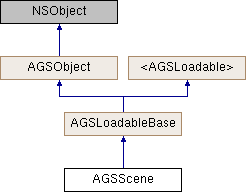
Instance Methods | |
| (void) | - cancelLoad |
| (instancetype) | - initWithBasemap: |
| (instancetype) | - initWithBasemapType: |
| (instancetype) | - initWithItem: |
| (instancetype) | - initWithTilingScheme: |
| (nullable instancetype) | - initWithURL: |
| (void) | - loadWithCompletion: |
| (void) | - retryLoadWithCompletion: |
Class Methods | |
| (__nullable id< AGSJSONSerializable >) | + fromJSON:error: |
| (instancetype) | + scene |
| (instancetype) | + sceneWithBasemap: |
| (instancetype) | + sceneWithBasemapType: |
| (instancetype) | + sceneWithItem: |
| (instancetype) | + sceneWithTilingScheme: |
| (nullable instancetype) | + sceneWithURL: |
Properties | |
| AGSBasemap * | basemap |
| AGSSurface * | baseSurface |
| NSMutableArray< AGSBookmark * > * | bookmarks |
| AGSViewpoint * | initialViewpoint |
| AGSItem * | item |
| NSError * | loadError |
| AGSLoadSettings * | loadSettings |
| AGSLoadStatus | loadStatus |
| NSMutableArray< AGSLayer * > * | operationalLayers |
| AGSSceneViewTilingScheme | sceneViewTilingScheme |
| AGSSpatialReference * | spatialReference |
| NSMutableArray< AGSFeatureTable * > * | tables |
| NSArray< AGSTransportationNetworkDataset * > * | transportationNetworks |
| NSDictionary< NSString *, id > * | unknownJSON |
| NSDictionary< NSString *, id > * | unsupportedJSON |
| NSString * | version |
Method Documentation
§ cancelLoad()
|
requiredinherited |
Cancels loading if it is in progress, otherwise it does nothing. This should be called carefully because other objects could be waiting for loadWithCompletion: or retryLoadWithCompletion: to complete and this will call them all back with the error of NSUserCancelledError
- Since
- 100
§ fromJSON:error:()
| + (__nullable id<AGSJSONSerializable>) fromJSON: | (id) | JSONObject | |
| error: | (NSError **) | error | |
Initializes and returns an object from its JSON representation.
- Parameters
-
JSONObject NSDictionaryorNSArraycontaining the JSON.error encountered during the operation, if any.
- Since
- 100.3
§ initWithBasemap:()
| - (instancetype) initWithBasemap: | (AGSBasemap *) | basemap |
Instantiates a scene with the given basemap
- Parameters
-
basemap to use with the scene
- Since
- 100
§ initWithBasemapType:()
| - (instancetype) initWithBasemapType: | (AGSBasemapType) | basemapType |
Instantiates a scene with the given basemap type
- Parameters
-
basemapType to use with the scene
- Since
- 100
§ initWithItem:()
| - (instancetype) initWithItem: | (AGSItem *) | item |
Instantiate a scene based on the given web scene item.
- Parameters
-
item that represents a web scene on ArcGIS Online or an on-premises portal. Item's type must be AGSPortalItemTypeWebScene.
- Since
- 100.3
§ initWithTilingScheme:()
| - (instancetype) initWithTilingScheme: | (AGSSceneViewTilingScheme) | tilingScheme |
Instantiates a scene with the given tiling scheme
- Parameters
-
tilingScheme to use with the scene
- Since
- 100.2.1
§ initWithURL:()
| - (nullable instancetype) initWithURL: | (NSURL *) | URL |
Instantiate a scene based on the given web scene URL. The URL you pass can be one of three basic types. Examples of these types are:
- Item details page: http://www.arcgis.com/home/item.html?id=<web_scene_id>
- Scene viewer page: http://www.arcgis.com/home/webmap/viewer.html?webmap=<web_scene_id>
- Item's rest endpoint: http://www.arcgis.com/sharing/rest/content/items/<web_scene_id>
- Parameters
-
URL of the web scene on ArcGIS Online or an on-premises portal
- Returns
- The scene created from the URL, or nil if an invalid URL is passed.
- Since
- 100.3
§ loadWithCompletion:()
|
requiredinherited |
Loads data for the object asynchronously. The completion block is invoked upon completion.
You can call this method any number of times, however only one attempt is made to load the data. If it is already loading, it will just continue to load (i.e. not force a reload). If it has already loaded successfully, the completion block will be invoked right away. If it has already failed to load, the completion block will be invoked right away with error previously encountered. This method supports multiple callers and will call them all back on completion. However, each caller's completion block will be invoked once and only once.
- Parameters
-
completion block that is invoked when object loads successfully or fails to load. An error is passed to the block if the object fails to load.
- Note
- The completion block is always invoked on the main thread.
- Since
- 100
- See also
- cancelLoadto cancel loading-
- retryLoadWithCompletion:to force reload
§ retryLoadWithCompletion:()
|
requiredinherited |
Tries to reload when an object has failed to load. This method should be called judiciously. It should be called when:
- you didn't have network connectivity earlier when it failed and you want to retry now that you have connectivity
- the server was down earlier when it failed and you want to retry
- the request is taking too long and you want to cancel it and retry, in which case you will first call
cancelLoadand then this method
If the data hasn't started loading, it will start loading. If it is already loading, it will just continue to load. If it has already loaded successfully, calls back right away. If it has already failed to load, tries again. This method supports multiple callers and will call them all back on completion. However, each caller's completion block will be invoked once and only once.
- Parameters
-
completion block that is invoked when object loads successfully or fails to load. An error is passed to the block if the object fails to load.
- Note
- The completion block is always invoked on the main thread.
- Since
- 100
§ scene()
| + (instancetype) scene |
§ sceneWithBasemap:()
| + (instancetype) sceneWithBasemap: | (AGSBasemap *) | basemap |
Instantiates a scene with the given basemap
- Parameters
-
basemap to use with the scene
- Since
- 100
§ sceneWithBasemapType:()
| + (instancetype) sceneWithBasemapType: | (AGSBasemapType) | basemapType |
Instantiates a scene with the given basemap type
- Parameters
-
basemapType to use with the scene
- Since
- 100
§ sceneWithItem:()
| + (instancetype) sceneWithItem: | (AGSItem *) | item |
Instantiate a scene based on the given web scene item.
- Parameters
-
item that represents a web scene on ArcGIS Online or an on-premises portal. Item's type must be AGSPortalItemTypeWebScene.
- Since
- 100.3
§ sceneWithTilingScheme:()
| + (instancetype) sceneWithTilingScheme: | (AGSSceneViewTilingScheme) | tilingScheme |
Instantiates a scene with the given tiling scheme
- Parameters
-
tilingScheme to use with the scene
- Since
- 100.2.1
§ sceneWithURL:()
| + (nullable instancetype) sceneWithURL: | (NSURL *) | URL |
Instantiate a scene based on the given web scene URL. The URL you pass can be one of three basic types. Examples of these types are:
- Item details page: http://www.arcgis.com/home/item.html?id=<web_scene_id>
- Scene viewer page: http://www.arcgis.com/home/webmap/viewer.html?webmap=<web_scene_id>
- Item's rest endpoint: http://www.arcgis.com/sharing/rest/content/items/<web_scene_id>
- Parameters
-
URL of the web scene on ArcGIS Online or an on-premises portal
- Returns
- The scene created from the URL, or nil if an invalid URL is passed.
- Since
- 100.3
Property Documentation
§ basemap
|
readwritenonatomicstrong |
The scene's basemap.
- Since
- 100
§ baseSurface
|
readwritenonatomicstrong |
The base surface of this scene which provides an elevation context for the basemap and operational layers. The layers may be draped on or offset from this surface.
- Since
- 100
§ bookmarks
|
readnonatomicstrong |
The bookmarks associated with the scene
- Note
- This array does not allow duplicate objects.
- Since
- 100
§ initialViewpoint
|
readwritenonatomicstrong |
The scene's initial viewpoint. This is the area initially displayed by an AGSSceneView when the scene is used.
- Since
- 100
§ item
|
readnonatomicstrong |
The web scene item that was used to create the scene (if any)
- Since
- 100.3
§ loadError
|
readnonatomicstronginherited |
The error that was encountered during the most recent load operation. Will be nil if the operation succeeded.
- Since
- 100
§ loadSettings
|
readwritenonatomicstrong |
Settings that are applied to layers when the scene is loaded. Making changes to the settings after the scene is already loaded has no effect.
- Since
- 100.2
§ loadStatus
|
readrequirednonatomicassigninherited |
Status of the load operation.
- Since
- 100
§ operationalLayers
|
readnonatomicstrong |
The scene's operational layers. These layers are displayed in a sceneview sandwiched between a basemap's baseLayers at the bottom and referenceLayers at the top. The layers are drawn in a bottom-up fashion with the 0th layer in the list drawn first, next layer drawn on top of the previous one, and so on.
- Note
- This array does not allow duplicate objects.
- Since
- 100
§ sceneViewTilingScheme
|
readnonatomicassign |
The AGSSceneViewTilingScheme as used to render tile based data. The default value is AGSSceneViewTilingSchemeWebMercator. The tiling scheme property is used by the AGSSceneView to determine how to render tiled data. If this property was not set in advance of loading the scene it will be determined during the AGSScene::load. This will examine the AGSSpatialReference of the first tiled elevation source (see AGSArcGISTiledElevationSource) or tiled layer in the basemap or operational layers (see AGSArcGISTiledLayer) to choose either AGSSceneViewTilingSchemeGeographic or AGSSceneViewTilingSchemeWebMercator values. The AGSSceneViewTilingScheme must correspond to the AGSSpatialReference for those layers to render correctly.
- Since
- 100.2.1
§ spatialReference
|
readnonatomicstrong |
The scene's spatial reference.
Spatial references define where coordinates are located on the earth's surface and how the geographic content from the basemap and operational layers is aligned when combined together.
If a spatial reference wasn't provided when the scene was instantiated, it is typically derived from the bottom-most base layer in the basemap. If the scene does not have a basemap or if the basemap is empty, the spatial reference is derived from the bottom-most operational layer.
If the spatial reference of layers is different from that of the scene, the layers must be reprojected to the spatial reference of the scene before displaying. Some layers may not be able to re-project their data, for example layers based on tiles that have been pre-generated ahead of time. To maximize performance, avoid reprojection entirely by ensuring all layers have the same spatial reference as the scene.
- Since
- 100
§ tables
|
readnonatomicstrong |
List of non-spatial tables associated with the scene. These tables typically participate in one or more relationships with feature layers in the scene's operational layers.
- See also
- queryRelatedFeaturesForFeature:parameters:completion: (AGSArcGISFeatureTable)for performing related queries.
- Since
- 100.3
§ transportationNetworks
|
readnonatomiccopy |
A collection of transportation network datasets defined for the scene. Scene authors can use ArcGIS Pro to create mobile scene packages containing scenes that include transportation networks. If so, this property will be populated with the collection of AGSTransportationNetworkDataset objects. An AGSTransportationNetworkDataset from this collection can be used to construct one of the network analysis tasks (such as AGSRouteTask, AGSServiceAreaTask, and AGSClosestFacilityTask).
- See also
AGSRouteTask,AGSMobileScenePackage
- Since
- 100.7
§ unknownJSON
|
readnonatomiccopy |
A dictionary of values that was in the source JSON but was unparsed by API.
- Returns
NSDictionarycontaining the unknown JSON.
- Since
- 100.3
§ unsupportedJSON
|
readnonatomiccopy |
A dictionary of values that are supported by the REST API, but not exposed through the SDK API.
- Returns
NSDictionarycontaining the unsupported JSON.
- Since
- 100.3
§ version
|
readnonatomiccopy |
The web scene specification version that the output of #toJSON will comply with. This applies to how the scene is persisted.
- Since
- 100.3