Description
A location defined by x and y (and optionally z) coordinates.
AGSPoint geometries represent discrete locations or entities, such as a geocoded house address, the location of a water meter in a water utility network, a moving vehicle, and so on. Larger geographic entities (such as cities) are often represented as points on small-scale maps. Points can be used as the geometry of features and graphics and are often used to construct more complex geometries. They are also used in an AGSViewpoint to define the center of the display.
Points store a single set of x,y coordinates that define a location (longitude and latitude, for example), and an AGSSpatialReference. Optionally, a z-value (commonly used to describe elevation) can also be defined.
For points defined with a geographic spatial reference, the x-coordinate is the longitude (east or west), and the y-coordinate is the latitude (north or south). When geographic coordinates are represented in strings, they are generally written using the form "(latitude, longitude)", where the y-coordinate comes before the x-coordinate. Latitude values south of the equator and longitude values west of the prime meridian are expressed as negative numbers.
Use AGSCoordinateFormatter to convert a latitude, longitude formatted string directly to an AGSPoint, and also return a latitude, longitude formatted string from an existing AGSPoint. Other coordinate notations, such as Military Grid Reference System (MGRS) and United States National Grid (USNG) are also supported.
- Since
- 100
- Note
- This class represents an immutable point geometry, it cannot be modified after being created. Use
toBuilder (AGSPoint):to get a point builder.
- See also
AGSPointBuilderto construct or modify points programmatically.-
AGSSketchEditorto construct or modify geometries interactively by sketching on a map. -
AGSGeometryEngineto perform operations on geometries.
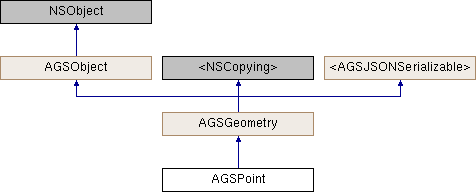
Instance Methods | |
| (instancetype) | - initWithCLLocationCoordinate2D: |
| (instancetype) | - initWithX:y:m:spatialReference: |
| (instancetype) | - initWithX:y:spatialReference: |
| (instancetype) | - initWithX:y:z:m:spatialReference: |
| (instancetype) | - initWithX:y:z:spatialReference: |
| (BOOL) | - isEqualToGeometry: |
| (BOOL) | - isEqualToGeometry: |
| (BOOL) | - isEqualToGeometry:tolerance: |
| (AGSPointBuilder *) | - toBuilder |
| (CLLocationCoordinate2D) | - toCLLocationCoordinate2D |
| (nullable id) | - toJSON: |
Class Methods | |
| (nullable id< AGSJSONSerializable >) | + fromJSON:error: |
| (instancetype) | + pointWithCLLocationCoordinate2D: |
| (instancetype) | + pointWithX:y:m:spatialReference: |
| (instancetype) | + pointWithX:y:spatialReference: |
| (instancetype) | + pointWithX:y:z:m:spatialReference: |
| (instancetype) | + pointWithX:y:z:spatialReference: |
Properties | |
| AGSGeometryDimension | dimension |
| BOOL | empty |
| AGSEnvelope * | extent |
| AGSGeometryType | geometryType |
| BOOL | hasCurves |
| BOOL | hasM |
| BOOL | hasZ |
| double | m |
| AGSSpatialReference * | spatialReference |
| NSDictionary< NSString *, id > * | unknownJSON |
| NSDictionary< NSString *, id > * | unsupportedJSON |
| double | x |
| double | y |
| double | z |
Method Documentation
§ fromJSON:error:()
|
staticrequiredinherited |
Initializes and returns an object from its JSON representation.
- Parameters
-
JSONObject NSDictionaryorNSArraycontaining the JSON.error encountered during the operation, if any.
- Since
- 100
§ initWithCLLocationCoordinate2D:()
| - (instancetype) initWithCLLocationCoordinate2D: | (CLLocationCoordinate2D) | locationCoordinate |
Initializes a point geometry with the provided location information.
- Parameters
-
locationCoordinate of the device
- Returns
- An initialized point geometry
- Note
- The point geometry is immutable, it cannot be modified after being created. Use
toBuilder:to get a builder to further modify the geometry.
- Since
- 100
§ initWithX:y:m:spatialReference:()
| - (instancetype) initWithX: | (double) | x | |
| y: | (double) | y | |
| m: | (double) | m | |
| spatialReference: | (nullable AGSSpatialReference *) | spatialReference | |
Initializes a point geometry with the provided coordinate values.
- Parameters
-
x The position along x-axis y The position along y-axis m The measure value spatialReference The coordinate system that the coordinate values use.
- Returns
- An initialized point geometry
- Note
- The point geometry is immutable, it cannot be modified after being created. Use
toBuilder:to get a builder to further modify the geometry.
- Since
- 100
§ initWithX:y:spatialReference:()
| - (instancetype) initWithX: | (double) | x | |
| y: | (double) | y | |
| spatialReference: | (nullable AGSSpatialReference *) | spatialReference | |
Initializes a point geometry with the provided coordinate values.
- Parameters
-
x The position along x-axis y The position along y-axis spatialReference The coordinate system that the coordinate values use.
- Returns
- An initialized point geometry
- Note
- The point geometry is immutable, it cannot be modified after being created. Use
toBuilder:to get a builder to further modify the geometry.
- Since
- 100
§ initWithX:y:z:m:spatialReference:()
| - (instancetype) initWithX: | (double) | x | |
| y: | (double) | y | |
| z: | (double) | z | |
| m: | (double) | m | |
| spatialReference: | (nullable AGSSpatialReference *) | spatialReference | |
Initializes a point geometry with the provided coordinate values. The minimum z-value is -6,356,752 meters, which is the approximate radius of the earth (the WGS 84 datum semi-minor axis). The maximum z-value is 55,000,000 meters.
- Parameters
-
x The position along x-axis y The position along y-axis z The position along z-axis m The measure value spatialReference The coordinate system that the coordinate values use.
- Returns
- An initialized point geometry
- Note
- The point geometry is immutable, it cannot be modified after being created. Use
toBuilder:to get a builder to further modify the geometry.
- Since
- 100
§ initWithX:y:z:spatialReference:()
| - (instancetype) initWithX: | (double) | x | |
| y: | (double) | y | |
| z: | (double) | z | |
| spatialReference: | (nullable AGSSpatialReference *) | spatialReference | |
Initializes a point geometry with the provided coordinate values. The minimum z-value is -6,356,752 meters, which is the approximate radius of the earth (the WGS 84 datum semi-minor axis). The maximum z-value is 55,000,000 meters.
- Parameters
-
x The position along x-axis y The position along y-axis z The position along z-axis spatialReference The coordinate system that the coordinate values use.
- Returns
- An initialized point geometry
- Note
- The point geometry is immutable, it cannot be modified after being created. Use
toBuilder:to get a builder to further modify the geometry.
- Since
- 100
§ isEqualToGeometry:() [1/2]
| - (BOOL) isEqualToGeometry: | (AGSGeometry *) | other |
Compares whether two geometries are equal.
- Parameters
-
other geometry to compare this geometry to
- Returns
- YES if the geometries are equal
- Since
- 100
§ isEqualToGeometry:() [2/2]
| - (BOOL) isEqualToGeometry: | (AGSPoint *) | other |
Compares whether two point geometries are equal.
- Parameters
-
other point to compare this point to
- Returns
- YES if the points are equal
- Since
- 100
§ isEqualToGeometry:tolerance:()
| - (BOOL) isEqualToGeometry: | (AGSGeometry *) | other | |
| tolerance: | (double) | tolerance | |
§ pointWithCLLocationCoordinate2D:()
| + (instancetype) pointWithCLLocationCoordinate2D: | (CLLocationCoordinate2D) | locationCoordinate |
Initializes a point geometry with the provided location information.
- Parameters
-
locationCoordinate of the device
- Returns
- An initialized point geometry
- Note
- The point geometry is immutable, it cannot be modified after being created. Use
toBuilder:to get a builder to further modify the geometry.
- Since
- 100
§ pointWithX:y:m:spatialReference:()
| + (instancetype) pointWithX: | (double) | x | |
| y: | (double) | y | |
| m: | (double) | m | |
| spatialReference: | (nullable AGSSpatialReference *) | spatialReference | |
Initializes a point geometry with the provided coordinate values.
- Parameters
-
x The position along x-axis y The position along y-axis m The measure value spatialReference The coordinate system that the coordinate values use.
- Returns
- An initialized point geometry
- Note
- The point geometry is immutable, it cannot be modified after being created. Use
toBuilder:to get a builder to further modify the geometry.
- Since
- 100
§ pointWithX:y:spatialReference:()
| + (instancetype) pointWithX: | (double) | x | |
| y: | (double) | y | |
| spatialReference: | (nullable AGSSpatialReference *) | spatialReference | |
Initializes a point geometry with the provided coordinate values.
- Parameters
-
x The position along x-axis y The position along y-axis spatialReference The coordinate system that the coordinate values use.
- Returns
- An initialized point geometry
- Note
- The point geometry is immutable, it cannot be modified after being created. Use
toBuilder:to get a builder to further modify the geometry.
- Since
- 100
§ pointWithX:y:z:m:spatialReference:()
| + (instancetype) pointWithX: | (double) | x | |
| y: | (double) | y | |
| z: | (double) | z | |
| m: | (double) | m | |
| spatialReference: | (nullable AGSSpatialReference *) | spatialReference | |
Initializes a point geometry with the provided coordinate values. The minimum z-value is -6,356,752 meters, which is the approximate radius of the earth (the WGS 84 datum semi-minor axis). The maximum z-value is 55,000,000 meters.
- Parameters
-
x The position along x-axis y The position along y-axis z The position along z-axis m The measure value spatialReference The coordinate system that the coordinate values use.
- Returns
- An initialized point geometry
- Note
- The point geometry is immutable, it cannot be modified after being created. Use
toBuilder:to get a builder to further modify the geometry.
- Since
- 100
§ pointWithX:y:z:spatialReference:()
| + (instancetype) pointWithX: | (double) | x | |
| y: | (double) | y | |
| z: | (double) | z | |
| spatialReference: | (nullable AGSSpatialReference *) | spatialReference | |
Initializes a point geometry with the provided coordinate values. The minimum z-value is -6,356,752 meters, which is the approximate radius of the earth (the WGS 84 datum semi-minor axis). The maximum z-value is 55,000,000 meters.
- Parameters
-
x The position along x-axis y The position along y-axis z The position along z-axis spatialReference The coordinate system that the coordinate values use.
- Returns
- An initialized point geometry
- Note
- The point geometry is immutable, it cannot be modified after being created. Use
toBuilder:to get a builder to further modify the geometry.
- Since
- 100
§ toBuilder()
| - (AGSPointBuilder*) toBuilder |
Returns a builder using a copy of this geometry as a starting off point. The builder can be used to make modifications to the geometry.
- Returns
- builder that can be used to modify or create point geometries.
- Since
- 100
- Note
- Operations on the builder affect only its own internal copy of the geometry. They do not affect this geometry.
Implements AGSGeometry.
§ toCLLocationCoordinate2D()
| - (CLLocationCoordinate2D) toCLLocationCoordinate2D |
Converts current point into CLLocationCoordinate2D.
- Since
- 100
§ toJSON:()
|
requiredinherited |
Returns JSON representation for this object.
- Parameters
-
error encountered during the operation, if any.
- Returns
NSDictionaryorNSArraycontaining the JSON.
- Since
- 100
Reimplemented in AGSPortalItem.
Property Documentation
§ dimension
|
readnonatomicassigninherited |
§ empty
|
readnonatomicassigninherited |
Indicates whether this geometry has any vertices.
- Since
- 100
§ extent
|
readnonatomicstronginherited |
Smallest, rectangular bounding-box that covers the geometry.
- Since
- 100
§ geometryType
|
readnonatomicassigninherited |
The type of this geometry.
- Since
- 100
§ hasCurves
|
readnonatomicassigninherited |
Indicates whether this geometry has curves.
- Since
- 100
§ hasM
|
readnonatomicassigninherited |
Indicates whether this geometry contains m (measure) values.
- Since
- 100
§ hasZ
|
readnonatomicassigninherited |
Indicates whether this geometry contains z coordinate values. Only 3D geometries contain z values.
- Since
- 100
§ m
|
readnonatomicassign |
An optional coordinate to define a measure value for the point.
M-values are used in linear referencing scenarios and may represent things like mile markers along a highway. Like z-values, every geometry can optionally store m-values with the point coordinates that comprise it. The default m-value is NaN. If an m-value is specified when a geometry is created, the new geometry will have m-values (AGSGeometry::hasM will be YES). Note that when you get m-values back from a geometry, the default value of NAN is returned for vertices that do not have m-values. A geometry with m-values is sometimes known as an m-aware geometry.
- Since
- 100
- See also
AGSGeometry::hasMto check if the geometry has measure values.
§ spatialReference
|
readnonatomicstronginherited |
The spatial reference associated with the gometry. It specifies the coordinate system for the geometry's x, y, and z coordinate values.
- Since
- 100
- Note
- Geometries that represent geographic locations should always have a spatial reference. Otherwise the coordinates of the geometry are meaningless.
§ unknownJSON
|
readrequirednonatomiccopyinherited |
A dictionary of values that was in the source JSON but was unparsed by API.
- Returns
NSDictionarycontaining the unknown JSON.
- Since
- 100
§ unsupportedJSON
|
readnonatomiccopyinherited |
A dictionary of values that are supported by the REST API, but not exposed through the SDK API.
- Returns
NSDictionarycontaining the unsupported JSON.
- Since
- 100
§ x
|
readnonatomicassign |
The position along x-axis.
- Since
- 100
§ y
|
readnonatomicassign |
The position along y-axis.
- Since
- 100
§ z
|
readnonatomicassign |
The z coordinate for the point.
Geometries can have z-values, indicating values along the z-axis, which is perpendicular to both the x-axis and y-axis. Z-values indicate height above or depth below a surface, or an absolute elevation. For example, z-values are used to draw the locations of geometries in an AGSSceneView. Note that geometries are not considered true 3D shapes and are draped onto surfaces in the view, or in some cases, drawn in a single plane by using z-values. Z-values are stored on AGSPoint and AGSEnvelope. Since AGSMultipoint, AGSPolyline, and AGSPolygon are created from a collection of AGSPoint, all types of geometry can have z-values.
Whether or not a geometry has z-values is determined when the geometry is created; if you use a method that has a z-value parameter, the new geometry will have z-values (AGSGeometry::hasZ will be YES). If you create geometries using constructors that take z-value parameters, or if you pass into the constructor points or segments that have z-values, the new geometry will have z-values. An AGSGeometry with z-values is sometimes known as a z-aware geometry.
It may be that not all vertices in your geometry have a z-value defined. NAN is a valid z-value used to indicate an unknown z-value. However, the default z-value is 0. When you get z-values from a geometry that does not have z-values, the default is 0. Check the AGSGeometry::hasZ to determine whether a z-value of 0 means that there are no z-values in the geometry or that the z-value in the geometry's coordinates really is 0.
- Since
- 100
- See also
AGSGeometry::hasZto check if the geometry has z values.