Description
Mutable collection of points of a multipoint geometry builder.
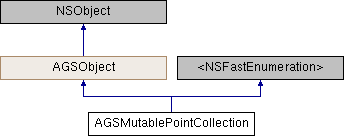
Instances of this class represent a mutable collection of points of a multipoint geometry builder (AGSMultipointBuilder).
This class adopts NSFastEnumeration which permits the collection to be enumerated conveniently using a for-in loop. For example -
This class also provides subscripting support. So you can access points using the subscript syntax. For example -
- Since
- 100
- See also
AGSMultipointBuilderfor multipoint geometry builder
Instance Methods | |
| (NSInteger) | - addPoint: |
| (void) | - addPoints: |
| (NSInteger) | - addPointWithX:y: |
| (NSInteger) | - addPointWithX:y:z: |
| (NSArray< AGSPoint * > *) | - array |
| (void) | - enumerateXYCoordinatesUsingBlock: |
| (NSInteger) | - indexOfPoint: |
| (instancetype) | - initWithSpatialReference: |
| (void) | - insertPoint:atIndex: |
| (void) | - insertPointWithX:y:atIndex: |
| (void) | - insertPointWithX:y:z:atIndex: |
| (AGSPoint *) | - pointAtIndex: |
| (AGSEnumerator *) | - pointEnumerator |
| (void) | - removeAllPoints |
| (void) | - removePointAtIndex: |
| (void) | - setObject:atIndexedSubscript: |
| (void) | - setPoint:atIndex: |
Class Methods | |
| (instancetype) | + pointCollectionWithSpatialReference: |
Properties | |
| NSInteger | count |
| BOOL | isEmpty |
| AGSSpatialReference * | spatialReference |
Method Documentation
§ addPoint:()
| - (NSInteger) addPoint: | (AGSPoint *) | point |
Add a point to the end of this collection
- Parameters
-
point to add
- Returns
- position where point was added. 0 is the first position
- Since
- 100
§ addPoints:()
| - (void) addPoints: | (NSArray< AGSPoint * > *) | points |
Add points from the provided array to the end of this collection
- Parameters
-
points to add
- Since
- 100
§ addPointWithX:y:()
| - (NSInteger) addPointWithX: | (double) | x | |
| y: | (double) | y | |
Add a point to the end of this collection
- Parameters
-
x coordinate of the point y coordinate of the point
- Returns
- position where point was added. 0 is the first position
- Since
- 100
§ addPointWithX:y:z:()
| - (NSInteger) addPointWithX: | (double) | x | |
| y: | (double) | y | |
| z: | (double) | z | |
Add a point to the end of this collection
- Parameters
-
x coordinate of the point y coordinate of the point z coordinate of the point
- Returns
- position where point was added. 0 is the first position
- Since
- 100
§ array()
| - (NSArray<AGSPoint*>*) array |
Returns an array of points.
- Since
- 100
§ enumerateXYCoordinatesUsingBlock:()
| - (void) enumerateXYCoordinatesUsingBlock: | (void(^)(NSUInteger index, double x, double y)) | block |
Allows you to enumerate the X and Y coordinates of this point collection with a block. This is faster than other ways of enumerating the part that give out AGSPoint instances.
- Since
- 100.5
§ indexOfPoint:()
| - (NSInteger) indexOfPoint: | (AGSPoint *) | point |
Returns the index of the specified point.
- Parameters
-
point whose index needs to be located.
- Returns
- An index of specified point
- Since
- 100
§ initWithSpatialReference:()
| - (instancetype) initWithSpatialReference: | (nullable AGSSpatialReference *) | spatialReference |
Initialize a collection with specified spatial reference. All points that belong to this collection must have the same spatial reference, or if they don't have a spatial reference, it will be assumed that they contain coordinates that match this spatial reference.
- Parameters
-
spatialReference of the collection
- Returns
- Initialized collection of points
- Since
- 100
- Note
- Geometries that represent geographic locations should always have a spatial reference. Otherwise the coordinates of the geometry are meaningless.
§ insertPoint:atIndex:()
| - (void) insertPoint: | (AGSPoint *) | point | |
| atIndex: | (NSInteger) | index | |
Insert a point at the specified position
- Parameters
-
point to insert index of desired position. 0 is the first position
- Since
- 100
§ insertPointWithX:y:atIndex:()
| - (void) insertPointWithX: | (double) | x | |
| y: | (double) | y | |
| atIndex: | (NSInteger) | index | |
Insert a point at the specified position
- Parameters
-
x coordinate of the point y coordinate of the point index of desired position. 0 is the first position
- Since
- 100
§ insertPointWithX:y:z:atIndex:()
| - (void) insertPointWithX: | (double) | x | |
| y: | (double) | y | |
| z: | (double) | z | |
| atIndex: | (NSInteger) | index | |
Insert a point at the specified position
- Parameters
-
x coordinate of the point y coordinate of the point z coordinate of the point index of desired position. 0 is the first position
- Since
- 100
§ pointAtIndex:()
| - (AGSPoint*) pointAtIndex: | (NSInteger) | index |
Returns the point at the specified index.
- Parameters
-
index An index within the bounds of the collection.
- Returns
- The point located at the index
- Since
- 100
§ pointCollectionWithSpatialReference:()
| + (instancetype) pointCollectionWithSpatialReference: | (nullable AGSSpatialReference *) | spatialReference |
Initialize a collection with specified spatial reference. All points that belong to this collection must have the same spatial reference, or if they don't have a spatial reference, it will be assumed that they contain coordinates that match this spatial reference.
- Parameters
-
spatialReference of the collection
- Returns
- Initialized collection of points
- Since
- 100
- Note
- Geometries that represent geographic locations should always have a spatial reference. Otherwise the coordinates of the geometry are meaningless.
§ pointEnumerator()
| - (AGSEnumerator*) pointEnumerator |
Returns an enumerator object that lets you access each object in the point collection.
- Since
- 100
§ removeAllPoints()
| - (void) removeAllPoints |
Remove all points from this collection
- Since
- 100
§ removePointAtIndex:()
| - (void) removePointAtIndex: | (NSInteger) | index |
Remove point at specified position
- Parameters
-
index of desired position. 0 is the first position
- Since
- 100
§ setObject:atIndexedSubscript:()
| - (void) setObject: | (AGSPoint *) | obj | |
| atIndexedSubscript: | (NSInteger) | idx | |
Returns the point at the specified index. Supports accessing an individual point using array-style subscript expressions.
- Parameters
-
idx An index within the bounds of the collection.
- Returns
- The point located at the index
- Since
- 100 */ -(AGSPoint*)objectAtIndexedSubscript:(NSInteger)idx;
/** Sets the point at the specified index. Supports assigning an individual point using array-style subscript expressions. For example -
- Parameters
-
obj segment to set idx subscript index
- Since
- 100
§ setPoint:atIndex:()
| - (void) setPoint: | (AGSPoint *) | point | |
| atIndex: | (NSInteger) | index | |
Replace existing point with the specified one
- Parameters
-
point to replace with index of point to replace
- Since
- 100
Property Documentation
§ count
|
readnonatomicassign |
The number of points in the collection.
- Since
- 100
§ isEmpty
|
readnonatomicassign |
Indicates whether the collection is empty or not.
- Since
- 100
§ spatialReference
|
readnonatomicstrong |
The spatial reference associated with points in the collection. It specifies the coordinate system for each point's x & y coordinate values. All points in this collection must have the same spatial reference, or if they don't have a spatial reference, it will be assumed that they contain coordinates that match this spatial reference.
- Since
- 100
- Note
- Geometries that represent geographic locations should always have a spatial reference. Otherwise the coordinates of the geometry are meaningless.