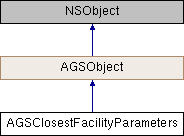
Input parameters for AGSClosestFacilityTask.
Instances of this class represent input parameters for finding closest facilities using AGSClosestFacilityTask.
- Note
- Consider using the convenience method
defaultClosestFacilityParametersWithCompletion: (AGSClosestFacilityTask) to get an instance of this class that is initialized with smart default values based on the task's metadata (AGSClosestFacilityTask::closestFacilityTaskInfo)
- Since
- 100.1
§ clearFacilities()
§ clearIncidents()
§ clearPointBarriers()
| - (void) clearPointBarriers |
|
|
|
§ clearPolygonBarriers()
| - (void) clearPolygonBarriers |
|
|
|
§ clearPolylineBarriers()
| - (void) clearPolylineBarriers |
|
|
|
§ searchWhereClauseForSourceName:()
| - (NSString*) searchWhereClauseForSourceName: |
|
(NSString *) |
sourceName |
|
Returns the filter used to specify which network elements stops can be located on. For example, if you have a network which has multiple sources such as streets, bus lines, air lines, etc., you could specify that facilities and incidents be located only on certain sources.
- Parameters
-
| sourceName | of the network element the filter applies to |
- Returns
- The filter specifiying which network elements can facilities and incidents be located on
- Since
- 100.1
§ setFacilities:()
| - (void) setFacilities: |
|
(NSArray< AGSFacility * > *) |
facilities |
|
Set the facilities to use in the analysis
- Parameters
-
- Since
- 100.1
§ setFacilitiesWithFeatureTable:queryParameters:()
Set the facilities to use in the analysis
- Parameters
-
| featureTable | containing point features to use as facilities |
| queryParameters | specifying which features to use |
- Since
- 100.1
§ setIncidents:()
| - (void) setIncidents: |
|
(NSArray< AGSIncident * > *) |
incidents |
|
Set the incidents to use in the analysis
- Parameters
-
- Since
- 100.1
§ setIncidentsWithFeatureTable:queryParameters:()
Set the incidents to use in the analysis
- Parameters
-
| featureTable | containing point features to use as incidents |
| queryParameters | to filter which features to use |
- Since
- 100.1
§ setPointBarriers:()
Set point barriers to avoid in the result route
- Parameters
-
| pointBarriers | barriers to avoid |
- Since
- 100.1
§ setPointBarriersWithFeatureTable:queryParameters:()
Set point barriers to avoid in the result route
- Parameters
-
| featureTable | containing point features to use as barriers |
| queryParameters | to filter which features to use |
- Since
- 100.1
§ setPolygonBarriers:()
Set polygon barriers to avoid in the result route
- Parameters
-
| polygonBarriers | barriers to avoid |
- Since
- 100.1
§ setPolygonBarriersWithFeatureTable:queryParameters:()
Set polygon barriers to avoid in the result route
- Parameters
-
| featureTable | containing polygon features to use as barriers |
| queryParameters | to filter which features to use |
- Since
- 100.1
§ setPolylineBarriers:()
Set polyline barriers to avoid in the result route
- Parameters
-
| lineBarriers | barriers to avoid |
- Since
- 100.1
§ setPolylineBarriersWithFeatureTable:queryParameters:()
Set polyline barriers to avoid in the result route
- Parameters
-
| featureTable | containing polyline features to use as barriers |
| queryParameters | to filter which features to use |
- Since
- 100.1
§ setSearchWhereClause:forSourceName:()
| - (void) setSearchWhereClause: |
|
(NSString *) |
searchWhereClause |
| forSourceName: |
|
(NSString *) |
sourceName |
|
|
| |
Specifies which network elements facilities and incidents can be located on. For example, if you have a network which has multiple sources such as streets, bus lines, air lines, etc., you could specify that facilities and incidents be located only on certain sources.
- Parameters
-
| searchWhereClause | The filter specifiying which network elements facilities and incidents can be located on |
| sourceName | the network elements the filter applies to |
- Since
- 100.1
§ accumulateAttributeNames
| - (NSArray<NSString*>*) accumulateAttributeNames |
|
readwritenonatomiccopy |
A list of network attributes to be accumulated and returned as part of the result. You might want to perform the analysis using a distance-based impedance attribute and accumulate a time-based cost attribute. Available attributes are specified by AGSClosestFacilityTaskInfo::accumulateAttributeNames. These attributes represent costs such as Drive Time, Distance, Toll expenses, etc.
- Since
- 100.1
§ defaultImpedanceCutoff
| - (double) defaultImpedanceCutoff |
|
readwritenonatomicassign |
§ defaultTargetFacilityCount
| - (NSInteger) defaultTargetFacilityCount |
|
readwritenonatomicassign |
Specfies the default number of facilities to search for each incident. Each incident can specify its own value, but if they don't, this default will be used.
- See also
AGSIncident::targetFacilityCount
- Since
- 100.1
§ directionsDistanceUnits
The linear units to use while providing distances for turn-by-turn directions.
- Since
- 100.1
§ directionsLanguage
| - (NSString*) directionsLanguage |
|
readwritenonatomiccopy |
§ directionsStyle
The style to use for providing directions.
- Since
- 100.1
§ outputSpatialReference
§ returnDirections
| - (BOOL) returnDirections |
|
readwritenonatomicassign |
§ returnPointBarriers
| - (BOOL) returnPointBarriers |
|
readwritenonatomicassign |
§ returnPolygonBarriers
| - (BOOL) returnPolygonBarriers |
|
readwritenonatomicassign |
§ returnPolylineBarriers
| - (BOOL) returnPolylineBarriers |
|
readwritenonatomicassign |
§ returnRoutes
§ routeShapeType
Specifies the type of route geometry to return
- Since
- 100.1
§ startTime
The time the route begins. If not specified, defaults to the time the task is executed.
- Since
- 100.1
- See also
startTimeUsage
§ startTimeUsage
Determines whether the startTime is used as the time of departing from the facility or incident, or time of arriving at the facility or incident.
- Since
- 100.1
§ travelDirection
Specifies the direction of travel between facilities and incidents. The direction of travel may influence the facilities found if the network contains one-way streets or impedances based on the direction of travel. For instance, it might take 10 minutes to drive from a particular incident to a particular facility, but the journey might take 15 minutes traveling in the other direction, from the facility to the incident, because of one-way streets or different traffic conditions.
- Since
- 100.1
§ travelMode
Specifies the travel mode to use when computing the routes. A travel mode represents a collection of network settings, such as travel restrictions and U-turn policies, that determine how a pedestrian, car, truck, or other medium of transportation moves through the network.
- Since
- 100.1